
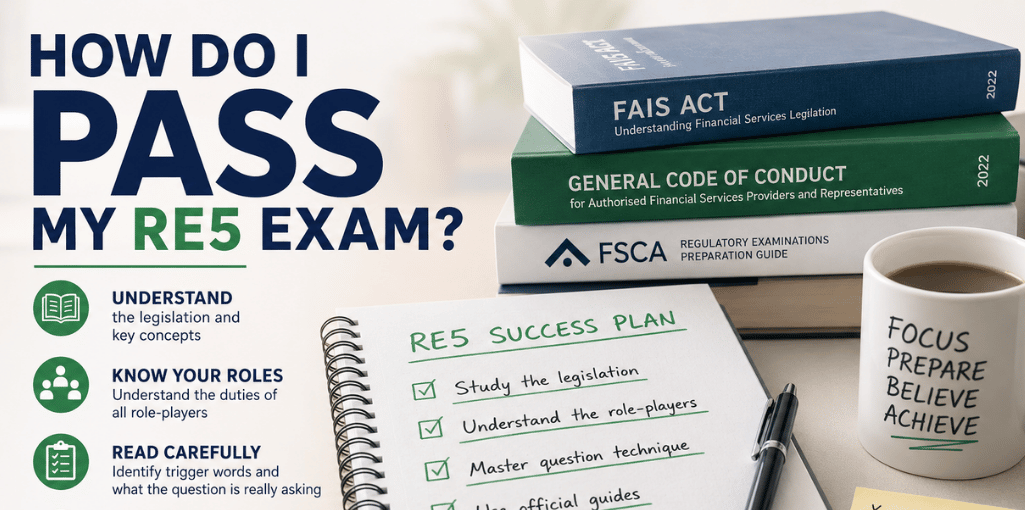
If there is one question I get asked more than any other during our RE5 workshops, it is this:
“How do I actually pass my RE5 exam?”
After training thousands of learners over the years, I have noticed something interesting. The people who pass are not always the smartest people in the room. They are not always the people who study the longest hours either.
The candidates who consistently pass the RE5 exam are usually the ones who understand how the RE5 exam preparation works and adjust their study approach accordingly.
The biggest mistake I see is candidates trying to memorise their way through the exam. That approach might work for some tests, but it is one of the fastest ways to fail RE5.
The Biggest RE5 Mistake Most Candidates Make
Many learners spend weeks memorising mock exam questions and answers.
They work through practice papers repeatedly and become confident because they recognise the answers. Then exam day arrives and they discover the questions have been reworded, the scenarios are different, and suddenly they are stuck.
The RE5 exam is not designed to test memory.
It is designed to test your ability to apply legislation and regulatory principles in real-world situations.
That means understanding will always beat memorisation.
If you rely solely on remembering answers, you will struggle when faced with scenario-based questions that require judgement and interpretation.
What You Should Be Doing Instead
Study the Legislation Directly
Many learners only focus on study notes.
Study notes are useful, but they should not replace the actual legislation.
Spend time reviewing:
- The FAIS Act
- The General Code of Conduct
- FSCA regulatory guidance
- Official RE5 preparation materials
You do not need to become a lawyer.
You do need to understand why the rules exist and what they are trying to achieve.
Understand the Regulatory Landscape
One of the first things we teach learners is how the financial services ecosystem fits together.
Many candidates attempt to study individual rules before understanding the bigger picture.
This creates confusion.
Before diving into legislation, make sure you understand the roles of:
- The Client
- The Financial Services Provider (FSP)
- The Representative
- The Key Individual
- The Compliance Officer
- The Financial Sector Conduct Authority (FSCA)
Once you understand who is responsible for what, the legislation becomes significantly easier to understand.
Learn to Read Like a Professional
One of the biggest shifts we make during our workshops is teaching candidates how to read the material differently.
Many people read legislation like they are reading a novel.
That is a mistake.
Instead, ask yourself two questions:
- Why does this rule exist?
- What would this look like in my daily work?
Most RE5 legislation exists for one reason: consumer protection.
Once you understand that principle, many questions become easier to answer.
Why So Many Students Feel Overwhelmed
When learners first arrive at our workshops, many feel intimidated by the sheer volume of material.
They see hundreds of pages and immediately assume they need to memorise everything.
This creates anxiety before studying has even started.
The first thing we do is break the exam down into its core competencies.
Once learners understand the structure of the RE5 exam, it becomes far less intimidating.
Instead of seeing an endless wall of legislation, they begin to see a framework with specific topics, responsibilities, and learning outcomes.
The goal is not to know everything.
The goal is to understand the areas being tested.
The Four Areas That Cause the Most RE5 Failures
After working with thousands of candidates, four sections consistently cause the most problems.
General Code of Conduct
This is arguably the most important section in the entire exam.
It covers:
- Disclosure requirements
- Conflict of interest
- Advice processes
- Complaints handling
- Client interactions
Students often fail this section because they memorise definitions instead of understanding how the rules apply in practice.
Most questions are scenario-based and require you to identify the most compliant action.
Representative Duties, Supervision and Debarment
This section catches many candidates because of the strict timelines involved.
Students often confuse:
- Business days versus calendar days
- Notification periods
- Appeal periods
- Register update requirements
The wording is precise and the exam expects you to understand those distinctions.
FSP Licensing Categories and Product Categories
This is one of the most misunderstood topics in the RE5 exam.
Many candidates confuse:
- An FSP licence category
- A financial product category
- Product subcategories
The exam frequently tests your understanding of who is legally authorised to provide specific services.
Understanding the distinction is critical.
Fit and Proper Requirements
This area covers:
- Honesty and integrity
- Good standing
- Qualifications
- Experience
- Class of Business
- Continuous Professional Development (CPD)
Candidates often rely on assumptions based on their workplace experience instead of applying the actual regulatory requirements.
That usually leads to incorrect answers.
What Successful RE5 Candidates Do Differently
There are some common habits I see among learners who pass.
They:
-
- Focus on understanding rather than memorisation
- Learn the roles and responsibilities of key regulatory participants
- Work through scenario-based questions carefully
- Use official FSCA preparation guides
- Read legislation directly
- Take time to understand why rules exist
- Interestingly, many successful learners are not the fastest learners.
- They are simply the most methodical.
What Our Learners Have Taught Me
Over the years, I have received countless comments from learners after completing our workshops.
Some say the training helped them understand concepts they had struggled with for months.
Others mention that they finally learned how to “read with understanding” instead of simply trying to remember information.
Many arrive feeling overwhelmed by the pace and complexity of the material.
By the end of the training, the legislation begins to make sense because they understand how the pieces fit together.
That transformation happens when learners stop chasing answers and start building understanding.
My Most Important RE5 Exam Advice
If I could give you only one piece of advice the night before your exam, it would be this:
Slow down.
Most candidates who fail by one or two percent do not fail because they lacked knowledge.
They fail because they misread the question.
RE5 is often a test of reading discipline more than knowledge.
How to Approach Every Question
When you sit in the exam room:
-
-
-
- Read the scenario once for context
- Read it a second time looking for trigger words
- Watch for words like “except,” “not,” “must,” “may,” “calendar days,” and “business days”
- Try answering the question in your head before looking at the options
- Read every option completely before choosing an answer
-
-
Never assume Option A is correct simply because it sounds familiar.
The exam often includes multiple technically correct answers.
Your job is to find the most compliant answer.
The Night Before the Exam
The night before your RE5 exam is not the time to cram.
At that point, your knowledge level is largely set.
What matters now is being rested, focused, and calm.
Get some sleep.
Trust your preparation.
Walk into the exam knowing that you do not need to know every word of every regulation.
You simply need to understand the principles behind the rules and apply them carefully.
The candidates who succeed are rarely the ones who memorise the most.
They are the ones who read carefully, think critically, and understand the purpose behind the legislation.
Do that, and you give yourself the best possible chance of passing your RE5 exam.
Preparing for your RE5 or RE1? See our RE5 exam training options, including face-to-face workshops, online study, learner guides and practice exams.